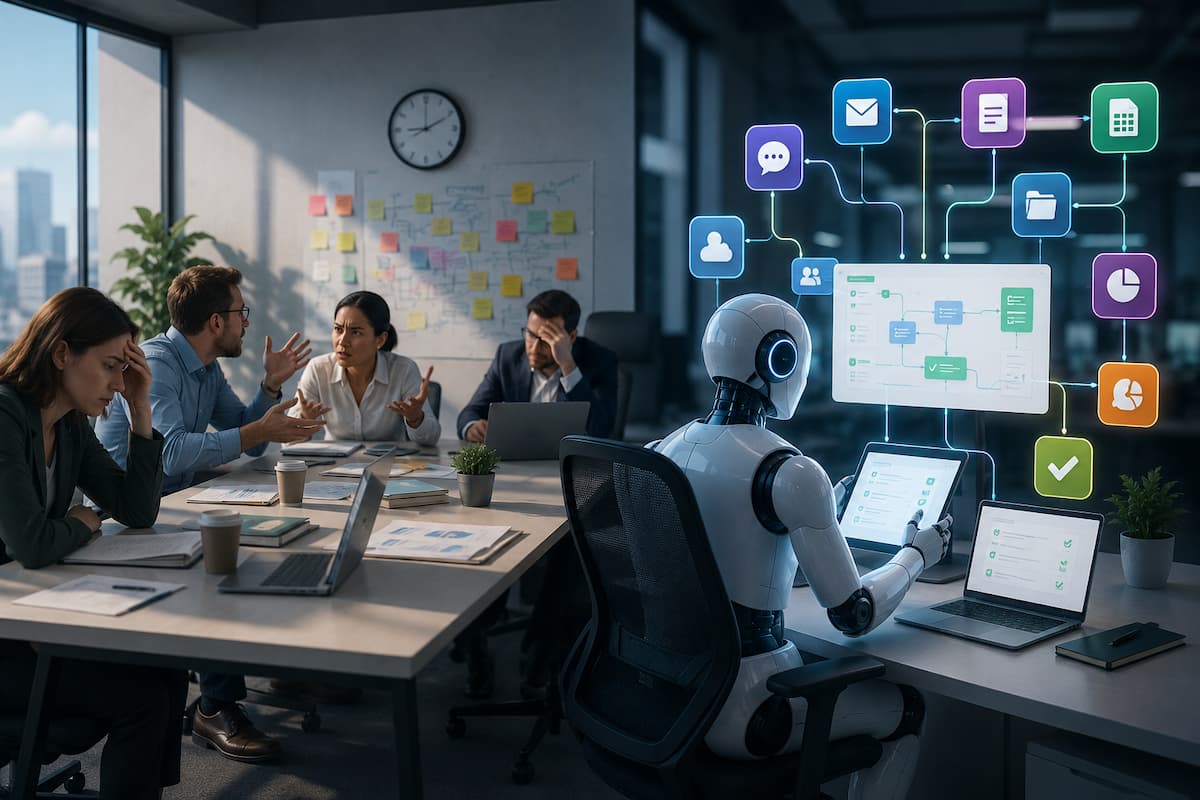
For decades, meetings have been considered the primary mechanism for coordinating teams, making decisions, and keeping organizations aligned. However, the rise of autonomous Artificial Intelligence agents is challenging one of the most deeply ingrained traditions in the corporate world: the need to gather people just to exchange information.
The next business revolution will not be about working faster, but about eliminating millions of unproductive hours currently consumed by unnecessary meetings.
The Silent Crisis of Corporate Productivity
Multiple studies have shown that knowledge workers dedicate between 20% and 40% of their workday to meetings. In large organizations, this figure can easily exceed 15 hours per week per employee.
The problem isn't strategic or creative meetings. The true cost stems from meetings whose sole purpose is to:
- Share status updates.
- Request routine approvals.
- Update information already available on other platforms.
- Synchronize schedules across multiple departments.
- Coordinate administrative tasks.
The Hidden Cost
When ten professionals participate in a one-hour meeting, the organization isn't investing a single hour—it is consuming ten hours of collective brainpower.
The Evolution of Corporate AI: From Digital Secretary to Autonomous Representative
The first generation of AI-driven tools focused on basic automation:
- Automated transcription.
- Meeting summaries.
- Action item extraction.
- Executive note generation.
Platforms like Zoom AI Companion, Microsoft Copilot, Notion AI, and Google Gemini began reducing the administrative burden that follows meetings.
However, the next phase is far more disruptive: AI agents are no longer just observing conversations. They are starting to actively participate in them.
The Dawn of Intelligent Asynchronous Synchronization
Imagine a global company with executives in New York, London, Bogotá, São Paulo, and Singapore.
Today, coordinating a meeting means finding compatible time zones, booking slots, preparing materials, and ensuring everyone involved can attend.
With autonomous agents, the process changes radically.
The New Corporate Decision-Making Workflow
- Each professional has an agent trained on their specific goals, priorities, and criteria.
- Agents automatically exchange information with one another.
- They analyze constraints, blockers, and opportunities.
- They propose optimal scenarios.
- They resolve simple conflicts on their own.
- They escalate only the strategic decisions that require human judgment.
What previously required a one-hour meeting can now be resolved in seconds through algorithmic negotiation.
The Technologies Leading This Transformation
CrewAI
A specialized framework for creating virtual teams of collaborative agents capable of debating, researching, and solving complex problems.
AutoGPT
One of the pioneering projects in autonomous goal execution using advanced large language models.
Notion AI
Centralizes corporate knowledge and automates documentation, significantly reducing the need for follow-up meetings.
Loom + AI
Enables teams to replace live meetings with asynchronous, on-demand video content.
Which Meetings Will Survive the AI Agent Revolution?
Not all meetings will vanish.
High-value human interactions will remain essential:
- Complex conflict resolution.
- Strategic negotiations.
- Organizational leadership.
- Disruptive innovation.
- Building company culture.
- Ethical decision-making.
AI primarily eliminates bureaucracy, not meaningful human collaboration.
The New Value of the Knowledge Worker
As operational coordination becomes automated, professional value shifts toward exclusively human capabilities:
Strategic Thinking
Making critical decisions under conditions of uncertainty.
Creativity
Generating novel ideas and innovative business models.
Leadership
Inspiring and coordinating people, rather than managing processes.
The Future Company Will Be Asynchronous by Default
The shift toward organizations powered by AI agents represents one of the most significant workplace transformations since the mass adoption of email and cloud computing.
The most innovative companies are already building environments where information flows automatically, routine decisions are delegated to intelligent systems, and live meetings are no longer the primary tool for coordination.
Conclusion: The End of Meetings Does Not Mean the End of Collaboration
The true promise of autonomous agents is not to replace workers, but to buy back their time.
Companies that embrace asynchronous, AI-driven work models will make faster decisions, lower operational overhead, and significantly boost overall productivity.
In a few years, looking back at daily status meetings will likely feel just as outdated and inefficient as sending a fax to share a document.