
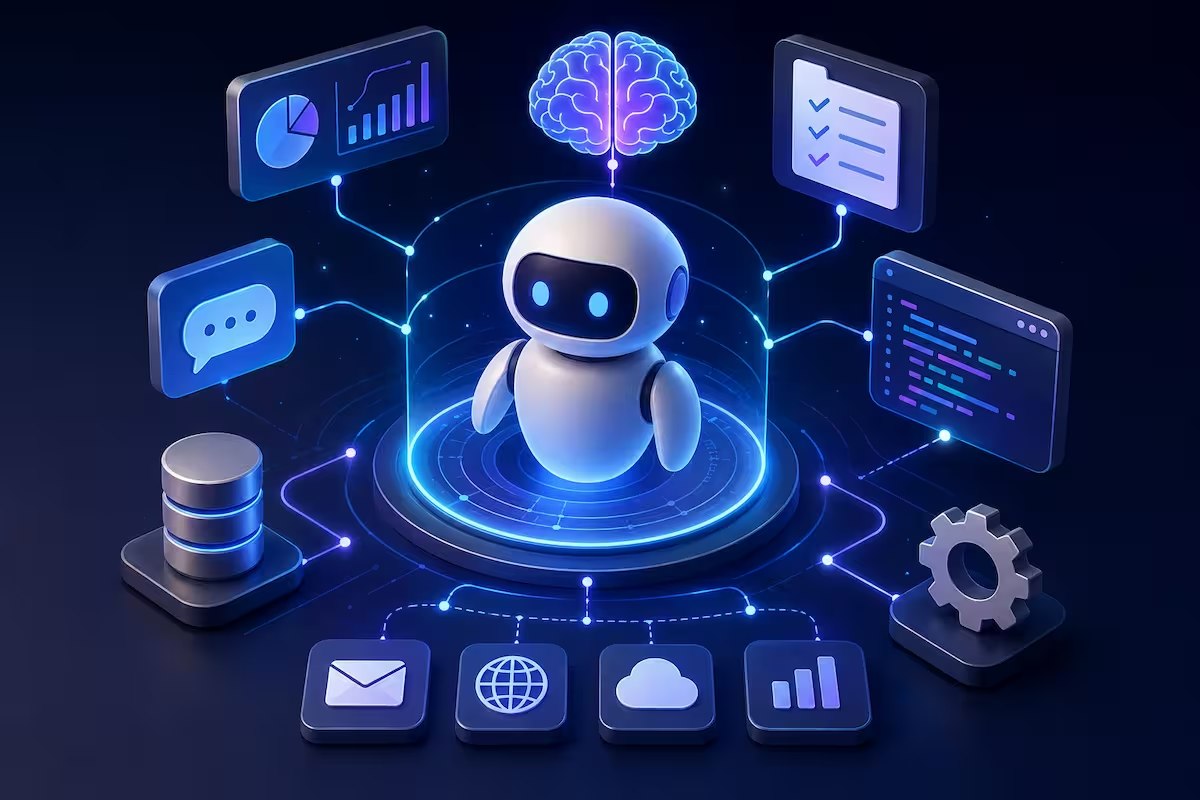
Discover how AI agents are transforming automation, productivity, software development, and business operations through autonomous decision-making and intelligent execution.
AI agents represent the next evolution of artificial intelligence. Unlike traditional chatbots, they can plan, reason, execute actions, use external tools, and continuously improve outcomes with minimal human supervision.
What Are AI Agents?
An AI agent is an autonomous software system capable of perceiving information, reasoning about goals, making decisions, and performing actions without requiring constant human input.
Modern AI agents combine large language models (LLMs), memory, planning systems, APIs, and automation tools to solve complex tasks.
How AI Agents Work
Perception
Reasoning
Planning
Execution
Memory
Types of AI Agents
Reactive Agents
Respond directly to environmental inputs.
Goal-Based Agents
Work toward predefined objectives.
Learning Agents
Improve performance from experience.
Autonomous Agents
Operate independently with minimal supervision.
Key Components of AI Agents
- ✓ Large Language Models (LLMs)
- ✓ Long-Term Memory Systems
- ✓ APIs and External Tools
- ✓ Planning and Reasoning Engines
- ✓ Autonomous Execution Frameworks
Multi-Agent Systems
Multi-agent architectures enable several specialized AI agents to collaborate, delegate tasks, exchange information, and solve highly complex problems more efficiently than a single agent.
Real-World Use Cases
Popular AI Agent Frameworks
- LangChain — Agent orchestration framework
- CrewAI — Multi-agent collaboration
- AutoGPT — Autonomous task execution
- OpenAI Agents SDK — Production-ready AI agents
- Zapier AI — Workflow automation
How to Build an AI Agent
- Define a clear objective.
- Select the appropriate framework.
- Integrate an LLM.
- Connect tools and APIs.
- Add memory capabilities.
- Test, monitor, and optimize.
Benefits
- 🚀 Increased productivity
- 💰 Reduced operational costs
- ⚡ Faster decision making
- 📈 Scalable automation
Limitations
- Potential hallucinations
- Security and privacy concerns
- Data dependency
- Governance challenges
The Future of AI Agents
AI agents are expected to become the digital workforce behind modern businesses. As reasoning models improve, agents will manage workflows, collaborate with humans, and automate entire operational processes.
Frequently Asked Questions
What is an AI agent?
An autonomous system capable of reasoning and acting to achieve goals.
Are AI agents replacing traditional software?
Not entirely. They complement traditional systems by adding autonomy and decision-making capabilities.
Are AI agents the future?
Yes. They are becoming a foundational technology for business automation and digital transformation.